
How Not to Use ChatGPT Like an Idi*t?
Thousands of engineers spent years to build A.I. that actually works for the public (fool proof). Still, “the public” always finds ways to prove that stupidity and short-sightedness is more powerful than intellect.
We are lucky to live in times when we have all the knowledge of the Humanity (or at least most of it), all the power of technology (or at least the publicly available ones) at our disposal.
Thirty years ago, if you wanted to learn more about quantum physics, for example, you had to go to the library or the bookstore, ask friends and still get partial knowledge. Nowadays, you can search in Google for:
“quantum physics explained”
and you will get this:
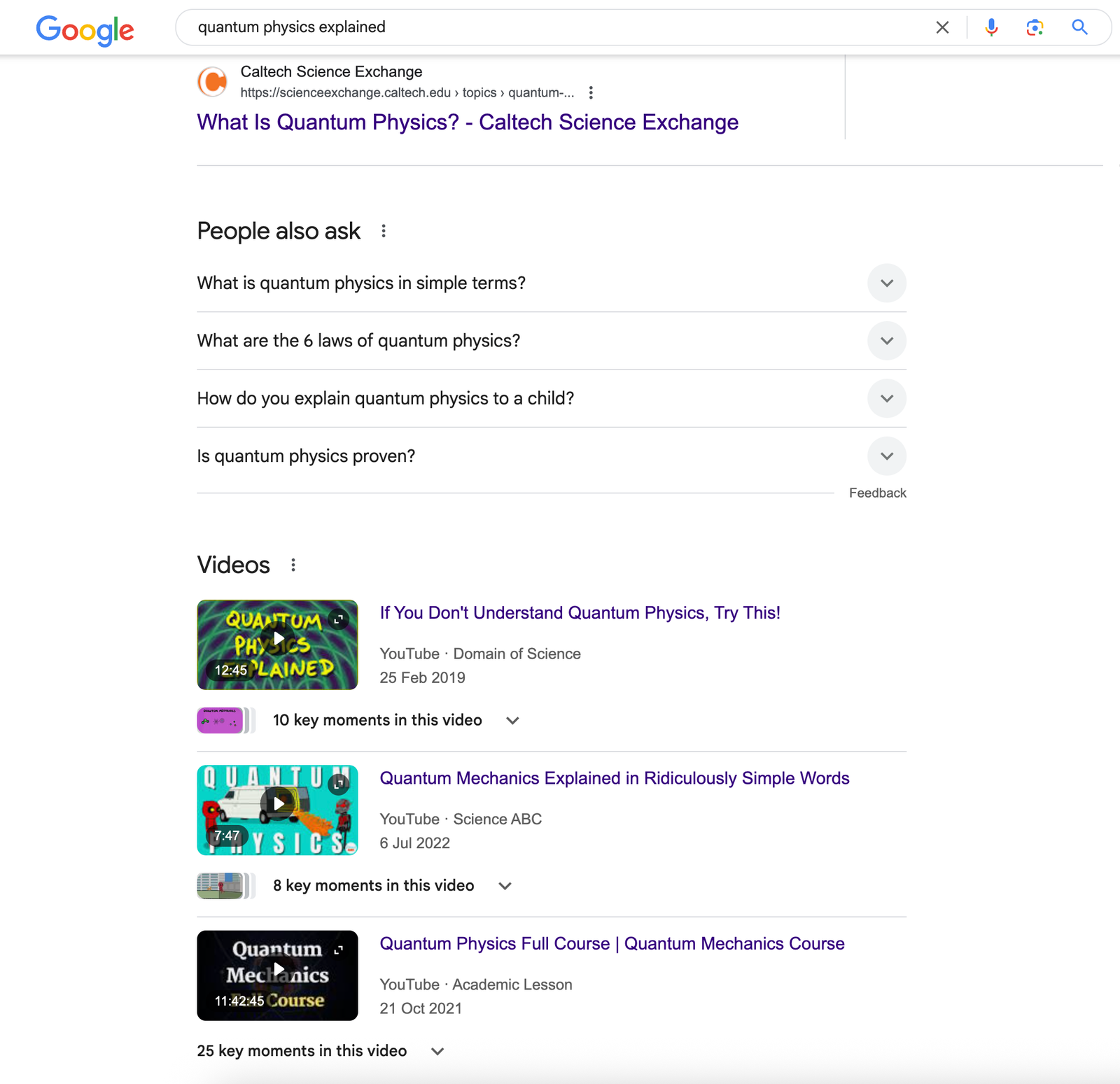
Basically, in 1 hour today, you will know more about Quantum Physics than after months of research back in 90s.
Or, you can just ask ChatGPT:
“Explain quantum physics under 500 words, so that a 10-years old to understand the concept.”
and you will get:
~~~~~~~
Imagine your world is made of LEGO bricks. Everything you see — cats, trees, video games, even you — is built from tiny building blocks called atoms. But atoms aren’t the smallest things. Inside them, there are even tinier pieces: electrons, protons, neutrons, and more.
Quantum physics is the special set of rules that tells us how these tiny things behave.
But here’s the weird part:
Tiny things can be in two places at once.
Imagine throwing a ball, and instead of going left or right, it goes both ways at the same time. Sounds impossible, right? But electrons can do that. This is called superposition.
Looking changes everything.
If no one’s watching, the tiny particles can do crazy stuff. But the moment you look — poof! — they “decide” where to be or what to do. It’s like your toys behaving when you’re watching but going wild when you leave the room.
They can be magically linked.
Two tiny particles can be so connected that if one changes, the other changes instantly, even if it’s on the other side of the world. This is called entanglement, like having twin superheroes with walkie-talkie minds.
They don’t move like normal stuff.
Big things (like cars or dogs) follow simple rules. But tiny particles act more like waves, clouds, or possibilities than solid balls. It’s like they’re playing hide and seek with the universe.
So why care about this?
Because quantum physics helps us build amazing stuff, like:
Computers and smartphones
Lasers
Solar panels
MRI machines in hospitals
Super-fast computers in the future (quantum computers!)
In short:
Quantum physics is like the secret rulebook for the smallest pieces of everything. And the rules? They’re wild, weird, and totally different from what we see every day.
But without those strange rules, the world wouldn’t work — or even exist — the way it does.
Magic? No. Just quantum physics.
~~~~~~~
Do you understand? Now, you can learn anything you want. You can understand any concept. You can organize any volume of information. In minutes. As knowledge is power, nowadays you can basically achieve anything because you have the ultimate power right under your fingertips.
OK. We have all that power. Do we use it to achieve great things?
Not at all. Or at least, not all of us.
How NOT to Use ChatGPT (and AI in general)
Here are 10 samples of the dumbest ways to use AI in 2025.
“Write my whole master’s thesis. Now.”
Dumping a vague topic and expecting a full, quality thesis in one go.
Result: Garbage in, garbage out.
“Fix my marriage.”
People expect a chatbot to solve years of emotional damage.
It’s not your therapist. It’s not your partner. It’s not magic.
“Who will win the stock market next week?”
Predictive gambling requests.
It doesn’t know the future. Neither do you.
“Talk dirty to me.”
Yes, still. If that’s your plan for cutting-edge tech, please log off. This prompt is so common, that OpenAI had to implement filters for it.
“Make me rich.”
That’s the entire prompt.
No context. No problem defined. Just vibes and delusion.
“Write code for my entire SaaS product.”
No specs. No logic. Just “make the thing.”
It’s a coding assistant, not a CTO with superpowers.
“Do my job so I can chill.”
People set it up to fake productivity while they check out.
Then act surprised when quality tanks.
“Tell me what to do with my life.”
Life advice from a machine trained on Reddit threads.
Use your brain. Reflect. Decide.
“Summarize this thing I haven’t read yet.”
Lazy input = useless summary.
It’s not mind reading. It’s compression.
“Make me go viral.”
Again, zero input. Just wishes.
Virality isn’t a prompt. It’s a strategy. Built by humans. Over time.
Now, let’s get serious.
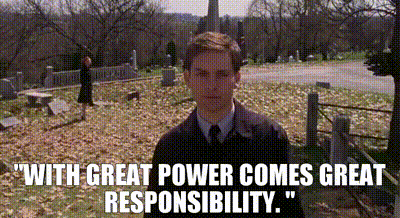
I am sure you have heard this quote:
How to Use ChatGPT the Smart Way
Yes, we have a great power in our hands and we have the responsibility to use it properly.
If we don’t do that, it is not only a bunch of missed opportunities, but also a disrespect to work of thousands of engineers who have been working developing such advanced technology and a total disrespect to our planet, considering the ecological impact of the data centers which run the AI engines.
So, let’s see thirty of the hundreds (thousands) ways to use ChatGPT, even with a simple prompt…
Rewrite boring emails
💡 Prompt:
“Make this email clear and professional, but not robotic. Keep it under 100 words.” + [Paste your draft] Brainstorm campaign ideas
💡 Prompt:
“Give me 10 creative campaign angles for a skincare brand targeting men over 40.”Draft a job description
💡 Prompt:
“Write a job ad for a junior marketing assistant in a luxury fashion brand in Dubai. Straightforward, no fluff.”Turn notes into slides
💡 Prompt:
“Convert these messy meeting notes into 5 clean bullet-point slides.” + [Paste notes]Interview prep
💡 Prompt:
“Ask me 10 tough interview questions for a head of operations role at a tech startup. Then critique my answers.”Turn customer reviews into insight
💡 Prompt:
“Summarize what people love and hate based on these reviews. Group by theme.” + [Paste reviews]Simplify legal jargon
💡 Prompt:
“Explain this paragraph like I’m a 12-year-old. No legalese.” + [Paste paragraph]Create templates
💡 Prompt:
“Build a reusable checklist for onboarding new clients to a design agency.”Write thoughtful birthday wishes
💡 Prompt:
“Write a short, witty birthday message for a colleague who loves Excel and red wine.”Prioritize your to-do list
💡 Prompt:
“Here are my tasks. Help me group and prioritize by impact and urgency.” + [Paste tasks]Fix a paragraph
💡 Prompt:
“This paragraph sounds messy. Clean it up without changing the meaning.” + [Paste paragraph]Prep meeting talking points
💡 Prompt:
“I have a Zoom call with a potential client. Generate a short bullet list of smart things to say based on this info.” + [Paste context]Compare tools
💡 Prompt:
“Compare Notion, Trello, and ClickUp for team project tracking. Highlight use cases, pros and cons.”Turn a long email into bullet points
💡 Prompt:
“Summarize this email in 5 bullets for my boss. Keep the tone neutral.” + [Paste email]Translate tone
💡 Prompt:
“Make this email more friendly and human. Keep the same message.” + [Paste email]Generate social hooks
💡 Prompt:
“Give me 10 opening lines for a post about burnout recovery. Honest, strong voice, no clichés.”Improve article titles
💡 Prompt:
“Suggest 10 punchy headlines for this blog post about personal finance mistakes.”Extract action items from transcripts
💡 Prompt:
“Highlight all actionable tasks from this meeting transcript.” + [Paste transcript]Create FAQ answers
💡 Prompt:
“Write clear, short FAQ answers for these 5 customer questions.” + [Paste questions]Convert a voice note into structure
💡 Prompt:
“Turn this transcribed voice note into a structured outline with headings.” + [Paste transcript]Build a weekly content plan
💡 Prompt:
“Plan 5 LinkedIn posts for the week around these 3 topics: marketing strategy, solopreneurship, automation.”Review a product description
💡 Prompt:
“Edit this product description to sound premium, clear, and persuasive. Max 3 sentences.” + [Paste text]Turn a list into a post
💡 Prompt:
“Take this list of lessons and turn it into a short story-style LinkedIn post with personality.” + [Paste list]Expand short notes into a brief
💡 Prompt:
“Turn this 3-line idea into a clear creative brief for a freelance designer.” + [Paste idea]Convert a blog into a carousel
💡 Prompt:
“Break this blog into 6 LinkedIn carousel slides. Each should have a strong title and 2-3 short bullet points.” + [Paste blog]Build user personas
💡 Prompt:
“Create 3 user personas based on this audience info: demographics, goals, pain points, behavior.” + [Paste info]Draft a training agenda
💡 Prompt:
“Create a simple 90-minute training agenda on productivity for remote workers.”Rewrite website copy
💡 Prompt:
“Make this homepage text more human, more direct, and more clear.” + [Paste text]Set up a cold outreach sequence
💡 Prompt:
“Write 3 cold email drafts for reaching out to HR tech startups about automation consulting. No fluff.”Ask better questions
💡 Prompt:
“Here’s what I’m trying to figure out. Suggest better, sharper questions I could ask.” + [Paste your goal or dilemma]—
Of course, those are just examples. The better and more detailed the prompt, the higher quality is the output.
👉 I am preparing a detailed guide on prompt engineering for non-tech people and will share it soon.
—
Try some of the above prompts and use AI for good and impactful purposes. Or you will get the worst pod (reference: The Matrix) when AI conquers the world.